


Asahan No.3 Hydroelectric Power Plant
174 MW run-of-river hydropower plant in North Sumatra, Indonesia — Detailed Design and Construction Supervision by Nippon Koei. Indonesia’s first hydropower project certified under the Hydropower Sustainability Standard (HSS).

Client
PT PLN (Persero)
Location
Asahan River, North Sumatra, Indonesia
Sector
Run-of-river Hydropower
Capacity
174 MW (2 × 87 MW) · Gross Head 196.0 m
Annual Energy Generation
1,477 GWh
Duration
June 2010 – December 2024 (Basic Design through Construction Supervision); commercial operation ongoing since December 2024
Financing
Japanese ODA Loan (JICA)
NK’s Role
Review of Feasibility Study, Basic Design, Detailed Design, Tender Assistance, Construction Supervision
Notable
Indonesia’s first hydropower project certified under the Hydropower Sustainability Standard (HSS); BIM piloted during the construction phase
Project Overview
North Sumatra’s power grid has long faced tight supply-demand balances, constraining both household electricity access and industrial growth in the Medan metropolitan area. Asahan No.3 was developed to address this gap — supplying additional power for incremental aluminium production at PT Inalum’s Kuala Tanjung smelter while meeting forecasted power demand across PLN’s North Sumatra grid.
Financed through a Japanese ODA Loan and developed on the Asahan River — the same river system where Nippon Koei’s founder first proposed hydropower development in the 1960s — the project reflects NK’s decades-long engagement with the region’s water resources. NK was engaged by PLN to review and update the project’s feasibility study, and subsequently to carry the project through Basic Design, Detailed Design, tendering, and Construction Supervision.

Project Timeline
Asahan No.2 (Siguragura/Tangga) hydropower plants constructed as part of the broader Asahan River comprehensive development program.
Original feasibility study for Asahan No.3 (rockfill dam concept) completed.
NK self-funds a feasibility restudy reformulating the project as a 174 MW run-of-river scheme; PLN adopts the revised concept.
JICA Loan approved; Detailed Design begins.
Engineering services contract signed with PT PLN (Persero); bidding process begins.

Land acquisition.
Main civil works begin (Lot I awarded to Shimizu – Adhi Karya Joint Operation).
Hydro-mechanical equipment, power generation equipment, and 150kV transmission line contracts awarded to specialist contractors.
Headrace tunnel breakthrough ceremony (Work Adit 2–3).
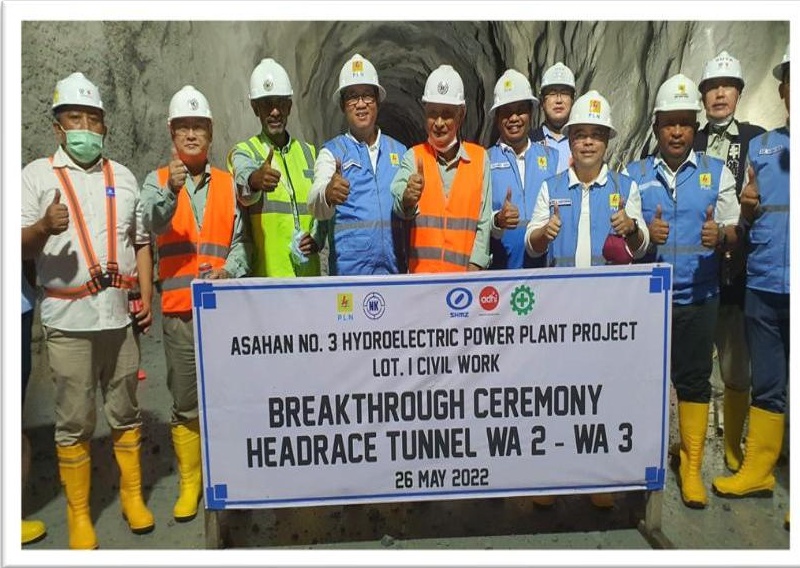
Civil and hydro-mechanical works completed; commissioning tests conducted.
Commercial operation begins.
Scope of Services
01
Feasibility Study Review
Updated and validated the project’s technical and economic feasibility ahead of design.
02
Basic Design & Detailed Design
Including field investigations to finalize the civil, hydro-mechanical, and electro-mechanical design.
03
Tender Assistance
Preparation of inception and design reports, technical specifications, prequalification and bid documents, cost estimates, and the implementation program; support for contract negotiation.
04
Construction Supervision
Oversight of civil works construction, including a 7.8 km headrace tunnel, a 106.7 m-long underground powerhouse cavern, and a 150kV transmission line.
05
Environmental & Social Monitoring
Ongoing monitoring throughout construction.
06
BIM Implementation Support
Introduced and piloted Building Information Modeling during the construction phase.
Results & Impact
174 MW
Installed run-of-river capacity (2 × 87 MW)
1,477 GWh
Estimated annual energy generation
7.8 km
Headrace tunnel
106.7 m
Underground powerhouse cavern
- Major civil works include a 7.8 km headrace tunnel, a 106.7 m-long underground powerhouse cavern, and a 150kV transmission line.
- Supports incremental aluminium production at PT Inalum’s Kuala Tanjung smelter and strengthens grid stability across North Sumatra.
- Indonesia’s first hydropower project certified under the Hydropower Sustainability Standard (HSS).
- Commissioned in December 2024, the culmination of a project history stretching back to feasibility studies in the 1980s.
Challenges & Solutions
Re-optimizing the design across decades
Long-duration hydropower projects often need to be revisited and re-optimized as conditions change over the years between initial planning and construction. Asahan No.3 illustrates this well: originally conceived in the 1980s as a rockfill dam with a peak-load power station, the scheme was later reformulated — through a feasibility restudy self-funded by NK in the 2000s — into a 174 MW run-of-river plant, a design PLN ultimately adopted. This kind of design re-optimization, balancing technical feasibility against environmental impact and cost, is a recurring discipline across NK’s hydropower work, not a one-off exercise specific to this project.
Tackling difficult ground on a 7.8 km headrace tunnel
Long headrace tunnels frequently pass through geologically difficult ground — sections of loose or unstable deposits, low rock cover, or unpredictable groundwater conditions — that can only be fully characterized once excavation is underway. On Asahan No.3’s 7.8 km headrace tunnel, one section proved to be particularly demanding ground. NK’s supervision team addressed it using established techniques for challenging tunnel conditions — additional pipe forepoling and the half-bench excavation method — successfully completing the section without compromising the schedule. This reflects a broader engineering capability: identifying difficult ground early through monitoring, and applying the right combination of support and excavation methods to keep a project safe and on track, a capability NK draws on across its tunnel and underground works portfolio.
Retrofitting BIM onto an already-underway project
Adopting new digital tools mid-project is another recurring challenge in long-running infrastructure work, since design and procurement decisions made years earlier are not always compatible with newer methods. On Asahan No.3, NK helped PLN pilot Building Information Modeling (BIM) starting midway through construction — running introduction seminars, building a 3D coordination model from existing 2D drawings, and using it for clash detection, VR walkthroughs, and AR-based progress tracking. The resulting Asset Information Model now links directly to O&M manuals and as-built drawings, giving the client a digital foundation for the plant’s operating life. The experience gained here — how to retrofit BIM workflows onto an already-underway project — is now informing how NK approaches digital adoption on other hydropower projects in Indonesia from an earlier stage.
Project Gallery
Related Services & Projects
Related Services
For more on our full-cycle hydropower development consulting — including the Procurement and Construction Supervision role illustrated by this project — see our Hydropower Development Consulting page.
Hydropower Development Consulting →Related Projects
Peusangan I & II HEPP — 88 MW, another PLN/JICA-financed hydropower project in Sumatra with a similarly long-running NK engagement.
View project →Upper Cisokan Pumped Storage Power Plant — Indonesia’s first pumped-storage project.
Projects page coming soon — link will be added once published.
Frequently Asked Questions
What is the Hydropower Sustainability Standard (HSS) certification that Asahan No.3 received?
The HSS is an international sustainability standard for hydropower projects, administered by the Hydropower Sustainability Alliance (HSA), assessing environmental, social, and governance performance. Asahan No.3 is the first hydropower project in Indonesia to be certified under this standard.
Why was BIM introduced only during the construction phase, rather than from the start of the project?
BIM was not part of the original design and procurement plans. At the client’s request during construction, NK introduced BIM through dedicated seminars and proposed it as a pilot implementation — demonstrating that BIM can still deliver value even when adopted mid-project, provided the team can adapt quickly.
Planning a Run-of-River Hydropower Project?
For inquiries about similar run-of-river hydropower development, or about BIM-enabled construction supervision on infrastructure projects, contact us.
Contact Us →