.svg)
Nippon Koei Indonesia Participates in IIGCE 2026, Highlighting Geoscience Expertise for Resilient Infrastructure Development
.jpg)
Date : Sept 2026
JAKARTA - Nippon Koei participated as an exhibitor at the Indonesia International Geothermal Convention & Exhibition (IIGCE) 2026, held from 19–21 August 2026 at the Jakarta Convention Center (JCC), Senayan.
Held under the theme “Energy Self-Sufficiency for a Stronger Indonesia: Geothermal as the Baseload Driving Energy Transition and Security,” the event brought together government representatives, industry players, investors, developers, and other stakeholders to discuss Indonesia’s geothermal industry, energy transition, and renewable energy development.
Indonesia’s Geothermal and Energy-Transition Agenda
The opening of IIGCE 2026 highlighted Indonesia’s efforts to strengthen energy self-sufficiency, reduce dependence on imported energy, and accelerate renewable energy development. Within this broader agenda, geothermal energy was presented as an important domestic energy source supporting the country’s energy security and transition toward a more sustainable energy mix.
The event provided a platform for industry stakeholders to exchange information, discuss current challenges, and explore opportunities related to geothermal development and supporting infrastructure.
For hydropower projects, this preparation can take many years. Aligning these different aspects of development can help reduce uncertainty, strengthen investment confidence and create a clearer pathway from project concept to implementation.
GEOHAZARD MANAGEMENT AND TECHNOLOGIES
At its exhibition booth, Nippon Koei presented information on geohazard management, multi-hazard maps, and satellite technology, highlighting their relevance to power plant development, infrastructure planning, and regional development.
Geohazard Management
We provide the highest-quality engineering consulting services across all disciplines to take projects through the entire life cycle. Depending on the project’s financial and contractual arrangements, we conduct all or a combination of the services shown below.

Nippon Koei's international Geohazard Management department provides comprehensive consulting services to effectively manage geohazards and associated risks. Our coverage of geohazards includes landslides, earthquakes, tsunamis, volcanoes, and floods. We manage all aspects, from hazard identification to risk reduction measures, non-structural and structural, proactive and reactive. Over the last 50 years, our department has contributed to geohazard management. We have developed and proven many technologies. Technology of tsunami simulation for risk management formulation, remote sensing technology, 3D simulation for Rockfall, VR Disaster Education System, utilization of AI technology, and many more.
Hazard Map, Precision for Safer Planning
Selecting the right location for infrastructure or urban development projects is often a complex challenge, particularly when viewed from the perspective of natural disaster risk prediction. To address this, our Hazard Map technology provides a reliable solution by identifying and recommending the safest areas for development. Some examples of development where our hazard map technology can make a significant impact include power plant development plans and urban/area development.
1. Hazard map for Power Generator Development

2. Hazard map for Urban/Area Development
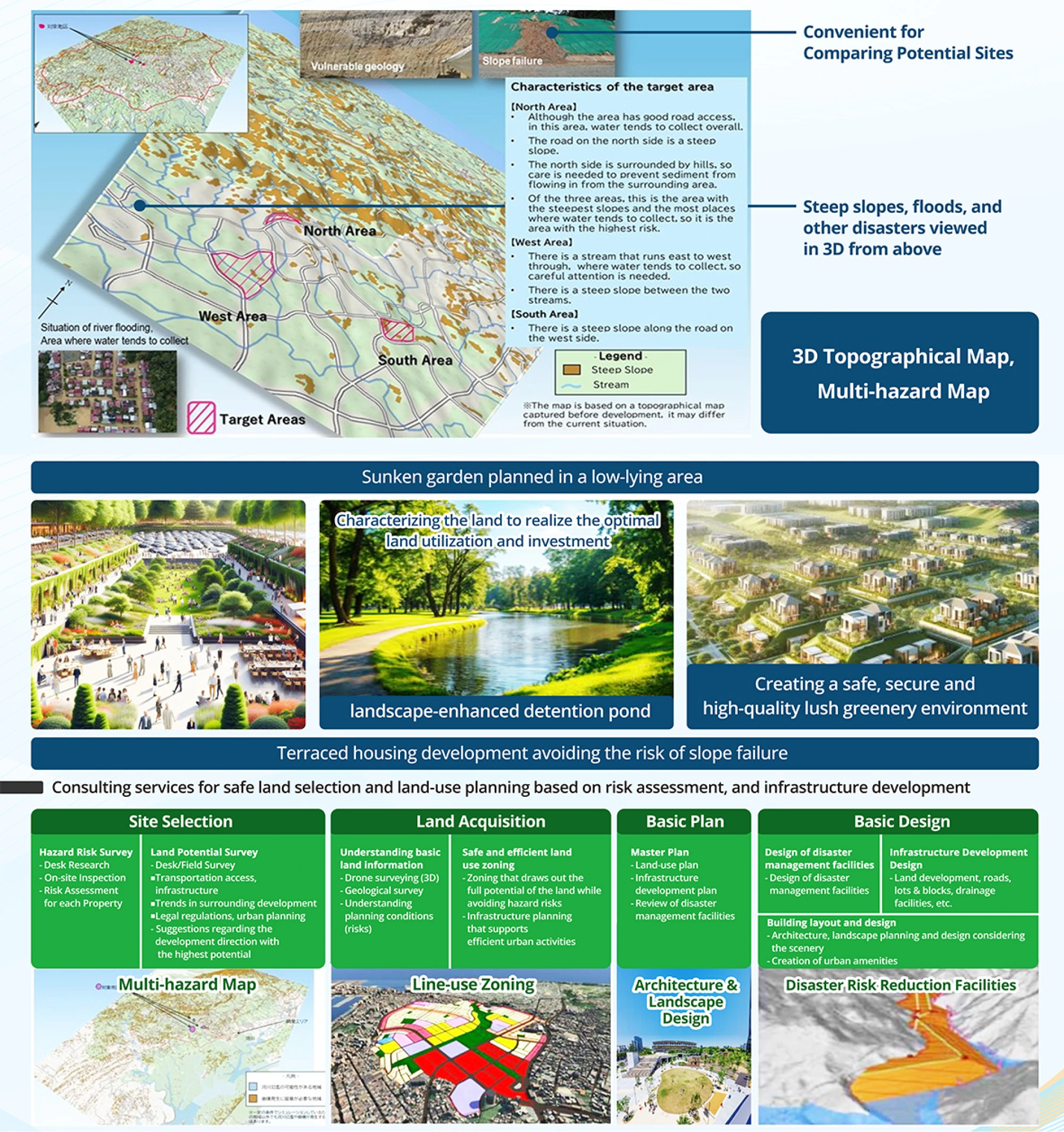
These capabilities are relevant to geothermal-related development and other infrastructure projects where geological conditions and natural-hazard risks need to be considered during planning and development. Through the materials presented at the booth, Nippon Koei introduced its engineering and geoscience experience in supporting risk-informed approaches to infrastructure and regional development.
Technical personnel from PT Indokoei International, Nippon Koei’s Indonesian subsidiary, also attended the booth. They are geologist and GIS Specialist that contributed to the discussions with visitors and stakeholders, providing additional technical insights related to the topics presented by Nippon Koei.
Industry Exchange and Collaboration
Beyond the exhibition of technical information, IIGCE 2026 provided opportunities for networking, information exchange, and discussions with visitors and other industry stakeholders. These interactions allowed Nippon Koei and the participating technical personnel to introduce relevant capabilities, exchange perspectives, and gain insights into current industry priorities and potential areas of future cooperation.
As Indonesia continues to pursue energy self-sufficiency and advance its geothermal and renewable energy agenda, collaboration among government institutions, investors, developers, consultants, and other industry participants will remain important.
Nippon Koei’s participation in IIGCE 2026 reaffirmed its interest in contributing to discussions surrounding Indonesia’s infrastructure and energy development, particularly through its engineering and geoscience capabilities in multi-hazard mapping and geohazard management.
For the country's energy transition, the ability to prepare projects well may be just as important as the resources themselves.
Picture Gallery of the Event of IIGCE 2026
.jpg)
Free Site Inspection Promotion
Nippon Koei is offering a complimentary site inspection by its engineers in Indonesia until December 2026.
For further information, please click the button below to download the promotional material. Alternatively, feel free to Contact Us to discuss how we can support your project.
.jpg)
What's New ?
JSCE Award FY 2024 For Asahan No. 3 Hydroelectric Power Project
Read articleJudul News 6
Memorandum of Agreement between the University of Hasanuddin and Nippon Koei
Read article


.png)
Jakarta Representative Office